Design process
AI UI Design Won’t Replace Designers. It Will Expose Bad Products Faster.
5 min
Posted on:
Updated on:
written by

Stan Murash
Writer

Yarik Nikolenko
Founder
reviewed by
“AI is the new UI. We don’t need designers anymore.”
“I keep seeing this take and it drives me crazy,” Tribe's founder Yarik told me. “Let's make a post out of it. I just want to rant.”
Here's what he had to say:
That conclusion is wrong.
Not because AI isn’t powerful. Not because designers just want to keep their jobs. But because the premise misunderstands what design actually is.
Yes, we’re in the era of vibe coding. Everyone is shipping faster. Interfaces can be generated in minutes. Flows, screens, even full prototypes appear almost instantly. This is the new reality and pretending otherwise is delusional.
Vibe coding is good. It’s fast. It gets ideas off the ground. It helps founders reach validation sooner than ever before.
The mistake happens after that.
Somewhere between “we built this in a week” and “AI UI design is the best thing ever”, people jump to the idea that design is now optional. That if software can spit out interfaces, the role of designers disappears.
That leap is where things fall apart.
Because real products don’t fail at launch. They fail when you try to grow them.
And that’s where AI-generated UI without design judgment starts to crack.
So, what you need to know about AI UI design as a tech founder? Let's hear from designers who do use AI in their work and are not afraid it will replace them anytime soon.
What UI Design AI Is Actually Good At
Let’s be clear: AI UI/UX design can be genuinely impressive.
AI is extremely good at turning vague ideas into something visual, getting teams unstuck, and compressing the time between “concept” and “something you can react to.” For startup design process, that’s a massive unlock. You can validate ideas faster, show tangible progress early, and reduce the cost of experimentation dramatically.
Used well, AI answers one question exceptionally fast: what could this look like?
That’s a valuable capability — but it’s also a limited one.
It doesn’t answer whether something should exist, which parts actually matter, or how a product should evolve once real users start pushing against it. Those questions don’t disappear just because the interface or landing page design looks polished.
Where Founders Start Drawing the Wrong Conclusion
The pattern is familiar. A founder uses AI UI design tools to generate a couple of screens. They look better than expected. So, founders ship quickly, get some early traction, and conclude that design is no longer a bottleneck.
At that stage, the product often does feel fine. Early products are simple by nature. There are fewer screens, fewer decisions, fewer edge cases. AI-generated UI holds up because there isn’t much pressure on the system yet.
The problem is that early success creates false confidence.
The jump from “this works right now” to “design is solved” is where long-term issues get baked in quietly. UI generation and product design start being treated as the same thing, even though they’re fundamentally different.
Products Don’t Fail at Launch. They Fail at Growth.
Most products don’t collapse on day one. They start breaking when complexity increases — when new features stack up, different people touch the interface, edge cases appear, and users behave in ways the original flow didn’t anticipate.
That’s when cracks show up: inconsistent patterns, confusing flows, interfaces that look fine but feel slightly off. Nothing is catastrophically broken, but everything becomes harder. Shipping slows down. Onboarding suffers. Support tickets increase. Conversion quietly drops.
This is design debt. And AI-generated UI doesn’t prevent it. In many cases, it accelerates it by making early decisions feel “finished” before they’re actually thought through.
Design Is Not About UI. It’s About Judgment.
The core misunderstanding is simple: UI is what you see; design is how decisions get made.
Design is deciding what not to build, which problems deserve complexity, and where simplicity matters more than completeness. It’s about consistency across hundreds of small choices, balancing speed with clarity, and making trade-offs under real business and technical constraints.
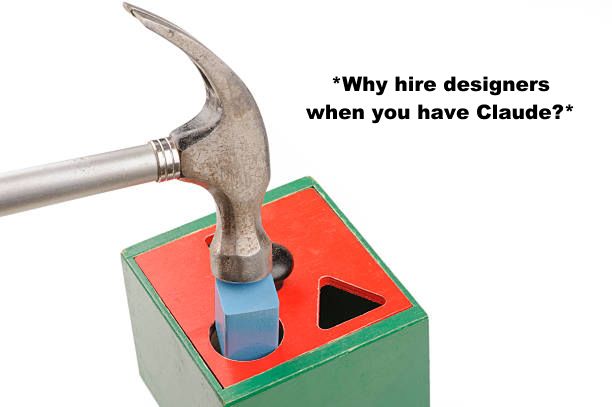
AI can generate options endlessly. It can’t take responsibility for decisions.
It doesn’t understand your business model, your users’ anxieties, or the long-term cost of short-term shortcuts. That’s not a temporary limitation — it’s the nature of the problem. Good design isn’t about producing screens. It’s about choosing directions and living with the consequences.
Why “Best AI Tools for UI Design” Is the Wrong Question
A lot of founders search for the “best AI UI design generator” hoping to find a silver bullet. The question itself isn’t wrong, but the expectation behind it often is.
There are plenty of tools that generate layouts, turn prompts into interfaces, or speed up early design work. They’re useful at the right stage. But tools don’t replace judgment, they amplify it.
If you already have clear priorities, taste, and direction, AI makes you faster. If you don’t, it simply helps you ship confusion more efficiently. The real question isn’t which tool is best; it’s what stage you’re at and what problem you’re actually trying to solve.
The Real Risk of AI UI Design
The biggest risk isn’t that designers disappear. It’s that founders mistake polish for clarity.
AI-generated interfaces often look “done” before they’re actually thought through. They feel complete, even when the underlying logic isn’t. That’s especially dangerous in products where trust matters — AI tools handling data, Web3 products handling money, fintech platforms managing risk, or developer tools asking for long-term adoption.
In these contexts, design is credibility.
When products rely too heavily on generated UI without design judgment, they start to feel generic and interchangeable. Users might not be able to explain why something feels off, but they feel it — and they leave.
Where AI Fits — And Where It Doesn’t (Yet)
AI is already part of modern product building. That’s not up for debate. The difference is between using AI to move faster and letting AI decide for you.
How designers actually integrate AI into real workflows — where it genuinely helps, where it introduces risk, and how it fits into decision-making — is a separate conversation. It’s an important one, and it deserves a proper breakdown. We’ll cover that next.
AI Raised the Bar. It Didn’t Eliminate Design.
AI didn’t kill design. It removed excuses.
Speed is no longer rare. Shipping fast is now table stakes. What still separates good products from forgettable ones is judgment, especially as things scale.
The teams that win won’t be the ones generating the most screens. They’ll be the ones making fewer mistakes, faster.
AI UI design helps you get started. Design helps you survive growth. And confusing the two is how promising products quietly fall apart.
Want a helping hand from a design team that can work quickly and make sound judgements? Get in touch with us.