Branding for startups
Branding For Web3: How Crypto Startups Build Trust Fast
10 min
Posted on:
Updated on:
written by

Stan Murash
Writer
reviewed by

Yarik Nikolenko
Founder
Branding for Web3 is a strange problem.
You’re building in a space that promises trustless systems — yet users still decide in seconds whether they trust your project. Between rug pulls, anonymous teams, and half-finished protocols, credibility is everything.
That’s why branding in crypto isn’t about flashy gradients or futuristic logos. It’s about looking legitimate enough that developers, investors, and partners actually take you seriously.
At Tribe, we see this a lot working with early-stage founders building AI and Web3 infrastructure — strong tech, but a brand that doesn’t yet signal the level they’re operating at.
Why Branding Matters More In Web3 Than In Any Other Industry
If you’re building a crypto startup, you’re operating in one of the lowest-trust industries on the internet.
Users are constantly exposed to rug pulls, anonymous founders, and projects that disappear overnight. Even legitimate teams have to fight against that backdrop. The result? People judge your project extremely fast — usually within a few seconds of landing on your website or reading your announcement.
That’s where branding for Web3 becomes critical.
Your brand isn’t decoration. It’s a credibility signal.
Before anyone reads your whitepaper, audits your code, or tests your protocol, they look at the basics:
Does the site feel professional?
Does the product look real?
Does the brand feel stable enough to trust with assets or integrations?
If those signals aren’t there, most people simply leave.
For early-stage teams especially, branding becomes the shortcut that tells the market: this project is serious. It’s the same reason strong startups invest early in positioning and identity, something we cover deeper in our guide to branding for startups.
This matters even more in Web3 because many projects rely on developers and ecosystem partners, not just customers. If your documentation, dashboards, or landing pages feel sloppy, developers will assume the product is too.
And developers don’t gamble their time easily.
According to research from the Ethereum developer ecosystem, developer adoption often follows projects that demonstrate strong documentation, clear positioning, and consistent communication — all things shaped by branding and design.
In other words:
In Web3, brand trust often comes before product trust.
The Biggest Branding Mistakes Web3 Startups Make
Most Web3 teams don’t ignore branding.
They just approach it the wrong way.
After working with early-stage founders building protocols, tools, and marketplaces, the same patterns show up again and again. The problem isn’t lack of effort — it’s optimizing for the wrong signals.
Trying to look “too crypto”
A lot of projects try to look like “crypto companies.”
Neon gradients. Abstract logos. Random mascots. Visuals that look futuristic but say nothing about the product.
The result is a brand that feels trendy but not trustworthy.
Ironically, the strongest Web3 brands tend to look simpler and more structured, similar to SaaS infrastructure tools. Clean typography, clear hierarchy, and predictable layouts build more trust than experimental aesthetics.
Designing for X instead of the product
Many Web3 brands are optimized for announcement graphics and X posts rather than actual product use.
Launch banners look great. But the website is confusing. Documentation is messy. The dashboard feels unfinished.
That disconnect breaks credibility.
Your brand needs to work across real product surfaces — something we discuss in our guide to the startup design process. Design isn’t just for marketing moments; it needs to support the entire user journey.
Ignoring developer audiences
A large portion of Web3 products are developer-first.
Protocols, SDKs, infrastructure tools, and marketplaces all rely on developers integrating, building, or contributing.
But many founders design their brand for investors or crypto X, not developers.
Developers care about clarity:
readable documentation
structured navigation
predictable UI patterns
This is why many successful developer ecosystems prioritize clear documentation hubs, as seen across projects in the broader Ethereum ecosystem.
Treating brand as decoration instead of infrastructure
The biggest mistake is treating brand as something you “add later.”
In reality, branding acts more like infrastructure. It shapes how your website communicates, how your docs are structured, and how your product feels to new users.
A good brand system also makes it easier to launch consistently across assets — websites, documentation, dashboards, and marketing pages. That’s exactly why marketing assets need to stay consistent across channels, something we explore in our breakdown of marketing design systems.
When Web3 startups get branding right, everything else becomes easier: product launches, ecosystem partnerships, and developer adoption.
The Core Elements Of A Strong Web3 Brand

Branding for Web3 works best when it solves a simple problem: credibility.
Not hype. Not aesthetics. Not the latest visual trend.
Early-stage crypto projects win trust when their brand makes the product feel clear, stable, and serious from the first interaction.
These are the core elements that usually make the difference.
Clear positioning inside the ecosystem
Many Web3 startups struggle with positioning because the ecosystem is complex.
Are you a protocol?
Infrastructure tooling?
A developer platform?
A marketplace?
An ecosystem program?
If people cannot quickly understand what role you play, they won’t spend time figuring it out.
Clear positioning helps developers, investors, and partners categorize your project immediately. That’s one reason strong startups begin with a structured branding foundation.
In Web3, clarity beats cleverness every time.
Developer-friendly design
A huge percentage of Web3 products are developer-facing.
Protocols rely on integrations. Infrastructure tools depend on developer adoption. Marketplaces and ecosystems need builders contributing to them.
That means branding has to work inside environments like:
documentation portals
GitHub repositories
dashboards
SDK guides
technical landing pages
If the design is chaotic or inconsistent, developers subconsciously assume the product itself might be unstable.
Strong developer ecosystems — including many projects in the broader Ethereum community — invest heavily in clear documentation design and structured user flows because developer experience directly influences adoption.
In other words, good branding makes the technical surface of your product easier to navigate.
Visual identity that signals trust
Web3 branding doesn’t need to look futuristic.
It needs to look credible.
Trust-focused identity systems usually prioritize:
simple logos that scale well across platforms
restrained color palettes
highly readable typography
consistent spacing and layout systems
These choices may look “boring” compared to NFT-era branding, but they build long-term trust.
Most founders underestimate how quickly people judge legitimacy based on visual quality. A clean interface, consistent branding, and structured layout communicate stability before a user reads a single sentence.
A brand system that works across ecosystems
Web3 projects rarely exist in one place.
Your brand has to work across multiple surfaces:
websites
documentation hubs
dashboards and apps
ecosystem partner pages
program landing pages
launch announcements
Without a system, every new asset ends up looking different.
That inconsistency weakens credibility and slows teams down. A structured brand system ensures every new asset — landing pages, program launches, marketing visuals — stays consistent.
In practice, the strongest Web3 brands aren’t just visually appealing.
They’re operational systems that help teams launch, scale, and communicate faster.
How Web3 Branding Differs From Traditional Startup Branding

Branding principles don’t completely change in Web3, but the environment around them does.
Crypto products grow differently from traditional startups, which means the brand needs to support different behaviors.
Community before customers
Most startups focus on acquiring customers.
Web3 projects often grow through communities first.
Before users even touch the product, they may interact with the brand through:
Discord servers
developer forums
governance discussions
social platforms like X
That means the brand becomes a community anchor.
Visual identity, tone of voice, and communication style need to work consistently across these spaces. If the brand feels chaotic or inconsistent, the community quickly loses confidence.
Token + product dual identity
Many Web3 projects operate with two parallel identities.
The product — dashboards, infrastructure tools, applications.
And the token ecosystem surrounding it.
These two layers often serve different audiences:
developers and technical users
traders and token holders
ecosystem partners
A strong Web3 brand needs to keep these narratives aligned so the project doesn’t feel fragmented.
Ecosystem-first growth
Traditional startups scale through sales or marketing funnels.
Web3 projects often grow through ecosystems and integrations.
Partnerships with protocols, developer programs, hackathons, and ecosystem grants frequently drive adoption. Because of this, projects need branding that adapts easily across multiple environments — partner landing pages, program websites, and integration announcements.
This is also why Web3 teams invest heavily in clear documentation and developer onboarding, something widely emphasized across the broader Ethereum developer ecosystem.
When branding supports ecosystem expansion, growth becomes easier. When it doesn’t, every partnership and launch requires rebuilding assets from scratch.
Branding Framework For Early-Stage Web3 Startups
Most Web3 founders overthink branding.
They assume they need a massive brand strategy document, complex visuals, or months of design work before launching.
In reality, early-stage teams benefit more from a lean branding framework that focuses on clarity and credibility first.
Here’s a simple approach that works well for Web3 startups.
Step 1 — Define your ecosystem role
Before touching logos or colors, clarify what role your project plays in the ecosystem.
Are you:
infrastructure tooling
a developer platform
a protocol
a marketplace
an education or community platform
Your role determines how the brand communicates value.
For example, infrastructure products typically benefit from clean, technical branding, while ecosystem programs may lean more into community-oriented visuals.
Without this clarity, branding often becomes vague and confusing.
Step 2 — Create a minimal brand system
Early Web3 startups don’t need massive design systems.
But they do need a basic brand foundation that keeps everything consistent.
This usually includes:
logo and symbol
primary color palette
typography
layout rules
visual hierarchy for product and documentation
These elements form the backbone of your design across every surface — your site, dashboards, documentation, and social assets.
Consistency matters more than complexity.
Step 3 — Launch a credibility-first website
Your website is usually the first place people evaluate your project.
Developers, investors, and partners all use it to quickly answer a few questions:
What does this project actually do?
Who is building it?
Why should I trust it?
Clear structure, readable design, and strong information architecture matter far more than visual experiments. If you want a deeper breakdown of how startup websites should be structured, we explain it in our guide to website design and development for startup founders.
A confusing site kills credibility instantly.
Step 4 — Build repeatable launch assets
Web3 teams launch new things constantly.
Programs. Ecosystem initiatives. Partnerships. Product features.
Instead of designing assets from scratch every time, strong brands build repeatable templates for:
landing pages
partnership announcements
program pages
social launch visuals
This keeps launches fast while maintaining a consistent identity.
At early stages, the goal of branding isn’t perfection.
It’s creating a system that helps your team ship confidently and consistently as the project grows.
Real Example: How Early Web3 Projects Actually Launch Brands
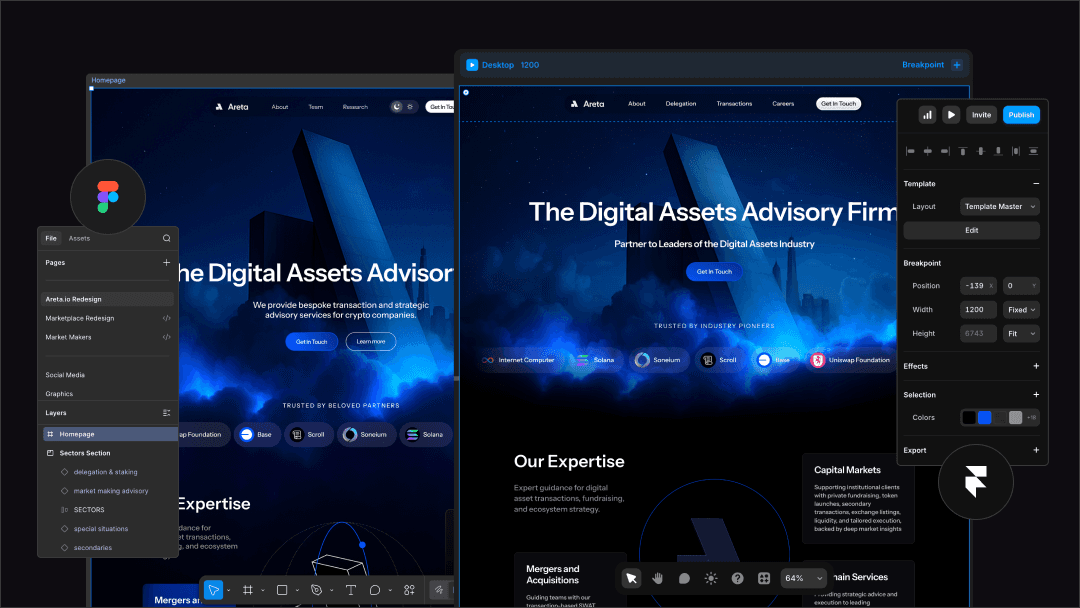
A good example of how Web3 branding works in practice is the work we did with Areta, a digital assets advisory firm building a marketplace that connects blockchain projects with verified audit providers.
A growing product with no scalable brand system
Areta already had a functioning advisory business, but the brand and website hadn’t kept up with the company’s evolution. At the same time, the team was launching Areta Marketplace, a new SaaS platform designed to match blockchain projects with trusted security auditors across ecosystems like Uniswap and Solana.
The challenge was not just designing a single site.
Each ecosystem partnership required its own landing page, marketing assets, and launch campaign. Without a structured design system, every launch would have required building assets from scratch.
Building a repeatable launch system
Instead of designing one-off pages, we built a repeatable marketplace launch system.
This included:
a new brand identity
a flexible landing page template for ecosystem launches
social media templates and marketing assets
UI/UX design for the marketplace product itself
Within four weeks, Areta launched its first marketplace landing page and supporting marketing campaign. The same system has since powered multiple ecosystem launches, allowing the team to scale their marketplace partnerships quickly.
The lesson is simple.
For Web3 startups, branding works best when it acts as infrastructure for launches, not just visual decoration.
FAQ

What is branding in Web3?
Branding in Web3 refers to the visual identity, positioning, and communication style that helps a crypto project build trust with developers, investors, and users. Because the space is full of anonymous teams and scams, branding often acts as an early credibility signal.
Why do crypto projects need strong branding?
Strong branding helps Web3 projects look trustworthy and professional. Developers, partners, and investors often evaluate a project’s legitimacy within seconds based on its website, documentation, and overall design quality.
What makes a good Web3 brand identity?
A strong Web3 brand identity focuses on clarity and credibility. It usually includes a simple logo, a consistent visual system, clear positioning within the ecosystem, and structured design across websites, dashboards, and documentation.
When should a Web3 startup invest in branding?
Most Web3 startups benefit from branding early — especially before launching a website, developer program, or ecosystem partnership. A minimal but credible brand foundation can significantly improve first impressions.
How much does branding cost for a Web3 startup?
Costs vary depending on scope, but early-stage projects often start with a lean branding system that includes a logo, visual identity, and launch-ready assets. More advanced systems typically evolve later as the product and ecosystem grow.
Key Takeaways

Branding for Web3 is primarily about trust. In a space full of scams and anonymous teams, credibility signals matter more than flashy visuals.
Clear positioning beats clever branding. If people cannot quickly understand your role in the ecosystem, they won’t spend time figuring it out.
Developer experience is part of your brand. Documentation, dashboards, and product interfaces often matter more than marketing graphics.
Most Web3 branding fails because it optimizes for hype. Strong projects focus on clarity, structure, and usability instead.
A brand system should support launches. Repeatable templates for landing pages, announcements, and partnerships help teams move faster.
Consistency across product, docs, and marketing builds credibility. When everything looks aligned, the project feels more legitimate.
Early-stage teams don’t need perfect branding. They need a clear, credible foundation that can evolve as the product grows.
Founders who understand this treat branding as infrastructure — a system that supports product launches, ecosystem partnerships, and community growth.
Feel like you need a second set of eyes on this?
Book a fit call and let’s see what we can build together.