Advertising Design for Startups: A Practical Guide for Founders

Good advertising design means compressing trust, clarity, and intent into a few square inches of screen space — usually in under three seconds.
Good advertising design aligns three things:
- The audience’s current mindset
- The offer being presented
- The visual hierarchy guiding attention
When those don’t align, you get pretty ads that don’t convert.
At Tribe, we see this constantly with early-stage founders: they think they need more design polish, when what they really need is sharper message compression.
Because good advertising design is controlled attention engineering.
How do you do it? Let’s see.
Key Takeaways
- Advertising design is about clarity under constraint — your message must land in seconds, not minutes.
- Startups can’t rely on brand recognition, so every ad must carry trust and legitimacy on its own.
- Strong visual hierarchy and one focused message consistently outperform cluttered, feature-heavy creatives.
- Specific beats broad — ads targeting a defined audience segment convert better than generic messaging.
- Consistency between ad creative and landing page design directly impacts conversion rates.
- Building reusable ad templates and asset libraries increases speed without sacrificing quality.
- In AI, SaaS, and Web3, real product visuals and concrete proof points build more trust than abstract branding.
Why Advertising Design Matters More For Startups
Big brands can afford mediocre ads.
Startups can’t.
If Nike runs a slightly confusing ad, people still click because they already trust the logo. If you’re a seed-stage AI startup nobody’s heard of? Your ad is your first impression.
And first impressions in frontier spaces — AI, Web3, fintech — carry extra weight. You’re asking users to trust you with data, money, or time. That’s a high bar.
Good advertising design shortens the trust gap.
Bad advertising design amplifies it.
For early-stage teams, every click costs real money. You don’t have unlimited brand awareness or performance budget to “test forever.” Which means your creative has to do more heavy lifting:
- Clarify the offer instantly
- Signal legitimacy
- Reduce perceived risk
- Guide attention to a single action
This is where many founders get it wrong. They treat ads like mini landing pages — cramming features, diagrams, taglines, and product shots into one cramped visual.
But advertising design for startups isn’t about showing everything.
It’s about isolating the one reason someone should care right now.
If you’ve read our breakdown of how marketing and design actually work together, you’ll notice the same theme: design isn’t separate from performance. It is performance.
For startups, advertising design is leverage.
Core Principles Of High-Performing Advertising Design
According to research from the Nielsen Norman Group, users scan rather than read — which means your ad must prioritize clarity over decoration. And platforms like Meta’s ad creative best practices emphasize simplicity and strong focal points for the same reason.
How do you do that?
Visual hierarchy
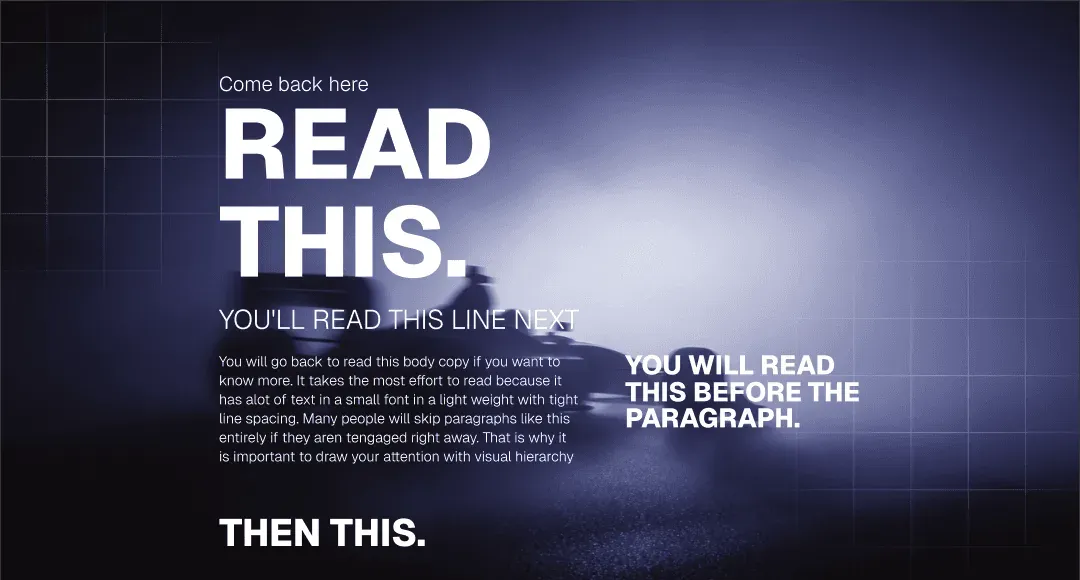
If everything is important, nothing is.
High-performing advertising design makes it obvious what to read first, second, and third. That usually means:
- One dominant headline
- One supporting visual or proof point
- One clear call to action
Strong hierarchy reduces cognitive load. Users shouldn’t have to “figure out” your ad. According to Google’s own creative guidance for display ads, clarity and focus outperform cluttered layouts in most cases.
If your eye doesn’t know where to land in the first second, the scroll wins.
Message clarity

Advertising design is not a brand manifesto.
It’s a single idea expressed clearly.
A common mistake: trying to explain the entire product in one creative. Instead, isolate one benefit per ad. Test variations. Let the campaign do the storytelling — not a single image.
Clear beats clever almost every time.
Single focus per creative
One audience.
One pain.
One promise.
The moment you design for “everyone,” performance drops.
High-performing ads are painfully specific. They look like they were made for you, not for the entire market. That’s not just copywriting — that’s design decisions, imagery, layout, and tone.
Brand consistency across campaigns
Performance marketing teams often sacrifice brand for short-term CTR.
That’s a mistake.
Your advertising design should feel connected to your broader visual identity. Otherwise, you’re building short-term clicks without long-term recognition.
If you haven’t built a coherent visual foundation yet, this is where branding for startups becomes critical. Advertising amplifies whatever brand clarity already exists — or exposes its absence.
Design for scroll environments
Your ad doesn’t live in isolation.
It lives inside a feed.
That means:
- High contrast
- Mobile-first layouts
- Clear focal points
- Fast readability
Users scan. They don’t admire.
Strong advertising design respects that reality — instead of fighting it.
Types Of Advertising Design Startups Actually Use
Most early-stage teams don’t need 25 ad formats.
They need a few that actually move the needle.
Here’s what that usually looks like.
Social media ad creatives
This is the core battlefield.
LinkedIn, X, Instagram, Meta — this is where attention lives. Social ad creatives typically combine:
- Bold headline
- Supporting visual or UI screenshot
- Light proof (metric, testimonial, logo)
- Clear CTA
The key is alignment. Your ad creative should visually and tonally match the landing page it sends traffic to. If the ad promises simplicity and the page feels chaotic, trust breaks instantly.
We go deeper into how design consistency affects performance in our guide to social media design.
Display ads
Banner ads get dismissed as outdated, but they still matter — especially in SaaS and B2B.
Here, restraint wins. Minimal copy. Strong contrast. Obvious CTA. These formats are even more constrained, which means hierarchy matters more.
Landing page ad alignment
Technically not an ad format — but critical.
Your advertising design doesn’t stop at the creative. The first impression of your landing page design must visually echo the ad.
Same headline logic. Same tone. Same visual cues.
If not, conversion drops.
Email campaign visuals
Underused by startups.
Clean, branded campaign visuals — not overdesigned templates — can significantly increase click-through rates in product launches or updates.
Check out our article on email marketing design to learn more if you want to focus on this channel.
Performance vs brand advertising assets
Early-stage teams skew heavily toward performance.
That’s fine.
But even performance ads are building brand memory. The smartest startups treat every ad as both a conversion tool and a brand-building touchpoint.
Because one-off ads don’t scale.
Systems do.
Why Most Startup Advertising Design Fails

Most startup ads don’t fail because of bad colors.
They fail because of confused thinking.
Here’s what we see over and over.
Too much information
Founders are close to the product, so they try to explain everything.
Features. Integrations. Roadmap. Mission. Screenshots. Testimonials.
All inside one cramped creative.
But advertising design doesn’t work like pitch deck design. It’s a trigger. Its job is to create curiosity or clarity — not full understanding.
The more you stuff in, the less people process.
Over-designed visuals
Ironically, some ads fail because they look too designed.
Heavy gradients. Abstract 3D shapes. Overly polished mockups. They look like Dribbble projects — not real offers solving real problems.
In performance environments, authenticity often beats spectacle. Especially in AI and Web3, where hype visuals already erode trust.
No offer clarity
If someone can’t answer “What do I get?” in two seconds, they scroll. This isn’t a design execution problem — it’s a strategic one.
Advertising design must make the value obvious:
- Save time?
- Increase revenue?
- Reduce risk?
- Learn faster?
Pick one.
If the design can’t support a clear offer, no amount of polish will fix it.
Inconsistent branding
When ads feel disconnected from your site or product, trust breaks.
This usually happens when startups outsource ad creatives to random freelancers without a system.
The result?
Short-term click spikes, long-term brand confusion.
Which is why advertising design should sit inside a broader design structure — not as an afterthought. Without that foundation, even good ads won’t compound.
Most startup advertising design doesn’t fail because of taste. It fails because there’s no framework behind it.
How To Build A Repeatable Advertising Design System
One good ad is luck. Consistent performance is a system.
Most startups approach advertising design reactively. Campaign launches → panic → designer rushes → assets go live → repeat.
That doesn’t scale.
Here’s what does.
Asset libraries
Instead of designing from scratch every time, build a structured marketing assets library:
- Pre-approved typography styles
- Color combinations optimized for contrast
- UI mockup components
- Proof elements (metrics, testimonials, logos)
- CTA variations
When performance marketers request a new creative, they’re assembling from a system — not reinventing the brand.
This dramatically increases speed without sacrificing consistency.
Templates vs custom

Templates aren’t lazy. They’re leverage.
High-performing startups identify 3–5 ad structures that work, then iterate messaging inside them. Layout stays consistent. Message rotates.
That way, you’re testing offers — not redesigning from zero every week.
Async design workflows
Advertising moves fast. Your design workflow should too.
If every creative requires a long kickoff call, alignment meeting, and feedback round, you’ll lose momentum. Async systems — clear briefs, shared files, tight feedback loops — keep production friction low.
We talk more about how structured workflows prevent design chaos in our guide to managing startup design process efficiently.
Embedded team vs freelance chaos
Freelancers can execute tasks. Embedded design partners understand context.
Advertising design compounds when the team creating ads understands your brand, your product, and your roadmap.
Because performance isn’t just about visuals but continuity.
Advertising Design Strategy For AI, SaaS & Web3 Teams
Frontier tech companies face a specific challenge: you’re often selling something abstract, technical, or unfamiliar.
That changes how advertising design should work.
Lead with credibility signals
If you’re in AI, Web3, fintech, or dev tooling, users are skeptical by default.
Your visuals should communicate stability and clarity:
- Clean typography
- Structured layouts
- Real product screenshots (not concept art)
- Concrete proof points (users, metrics, integrations)
Overly futuristic visuals, heavy gradients, and vague slogans can quickly feel like hype — especially in crypto-adjacent spaces.
Show the product early
Founders sometimes hide the interface behind big brand visuals. In technical markets, that’s a mistake.
Developers and operators want to see how it works. Even a partial UI screenshot builds more trust than abstract branding alone.
Reduce perceived risk
Your ad design should subtly answer unspoken objections:
- Is this secure?
- Is this legitimate?
- Is this built by real operators?
That can be handled visually through clarity, restraint, and consistency with your broader brand system. If that foundation is weak, advertising performance usually exposes it — which is why building on strong startup branding matters long term.
Speak to a specific segment
“AI tools for everyone” doesn’t convert.
“AI workflow automation for RevOps teams” does.
Design should reflect that specificity — through imagery, terminology, and layout emphasis.
In technical markets, precision outperforms noise.
Frequently Asked Questions

What is advertising design?
Advertising design is the strategic creation of visual assets used to promote a product or service across paid and owned channels. It combines layout, typography, imagery, and messaging to guide attention and drive a specific action — usually a click, signup, or purchase.
What makes advertising design effective?
Effective advertising design prioritizes clarity, hierarchy, and one focused message per creative. It aligns tightly with the target audience, highlights a concrete benefit, and maintains visual consistency with the landing page and overall brand system.
How is advertising design different from graphic design?
Graphic design can include anything from branding to packaging to presentations. Advertising design is more performance-driven. It’s built around conversion goals, audience targeting, and campaign testing — not just visual appeal.
How much should startups spend on advertising design?
There’s no fixed number, but early-stage teams should think in systems rather than one-off creatives. Investing in a reusable design framework or asset library often delivers better ROI than paying for isolated ad visuals without long-term consistency.
Should startups outsource advertising design?
If your team doesn’t have internal design capacity, outsourcing can work — but only if the designer understands your product and audience. Random, disconnected freelancers often produce inconsistent assets. A structured partnership or embedded model typically performs better over time.
What tools are best for advertising design?
Most startup teams use tools like Figma for design, combined with ad platform managers such as Meta Ads or Google Ads for deployment and testing. The tool matters less than the clarity of the message and the strength of the visual system behind it.
To sum up
If you want to zoom out and see how advertising fits into your larger growth engine, our deep dive on marketing and design systems breaks down how everything connects — from brand to campaign execution.
And if you feel like your ad creatives are “fine” but not converting the way they should, book a fit call and see what we can do for you.