Branding for startups
Early-Stage Startup Branding: How To Stay Consistent Across Every Channel
10 min
Posted on:
Updated on:
written by

Stan Murash
Writer
reviewed by

Yarik Nikolenko
Founder
Most early-stage startups don’t have a branding problem — they have a consistency problem.
The website says one thing. The pitch deck says another. Social posts feel like they belong to a different company. Emails sound like they were written by someone else entirely.
None of this happens on purpose. It’s what you get when things are built fast, by different people, across different tools.
But to users, investors, and customers, it signals one thing: uncertainty.
At Tribe, we see this constantly with early-stage teams — not bad brands, just fragmented ones that quietly erode trust.
Key Takeaways
People judge your credibility by how aligned your channels feel
You don’t need perfect branding — you need recognizable patterns
A lean system beats a bloated brand guideline every time
Define what stays consistent vs what can flex across channels
Templates help, but they shouldn’t replace thinking
“Good enough” branding = everything feels like the same company
Why Brand Consistency Matters More Than Perfect Branding
If you’re early, nobody knows you yet.
Which means people aren’t evaluating your brand deeply — they’re scanning for signals. And consistency is one of the fastest signals of credibility you can send.
Early-stage companies are judged fast
You don’t get the benefit of the doubt.
When someone lands on your site, clicks your LinkedIn, and opens your deck, they’re subconsciously asking:
“Does this feel like a real, put-together company?”
If each touchpoint feels slightly off — different tone, different visuals, different structure — it creates friction. Not enough to notice consciously, but enough to hesitate.
Inconsistency makes you look less credible
It’s not about aesthetics. It’s about coherence.
If your:
Website sounds polished
Social sounds casual
Deck sounds overly technical
You don’t look multi-dimensional — you look misaligned.
And misalignment reads as risk.
The goal is recognition, not perfection
Here’s where most founders get it wrong: they think branding is about getting everything “perfect.”
It’s not.
At this stage, the goal is simple:
When someone sees you in different places, it should feel like the same company showed up.
That’s it.
You don’t need a 60-page brand book.
You need a system that makes repetition easy and inconsistency hard.
What Early-Stage Startup Branding Actually Includes
Most founders reduce branding to visuals.
Startup logo. Colors. Maybe a nice-looking landing page.
That’s part of it — but it’s not the thing that actually creates consistency.
Brand is not just the logo
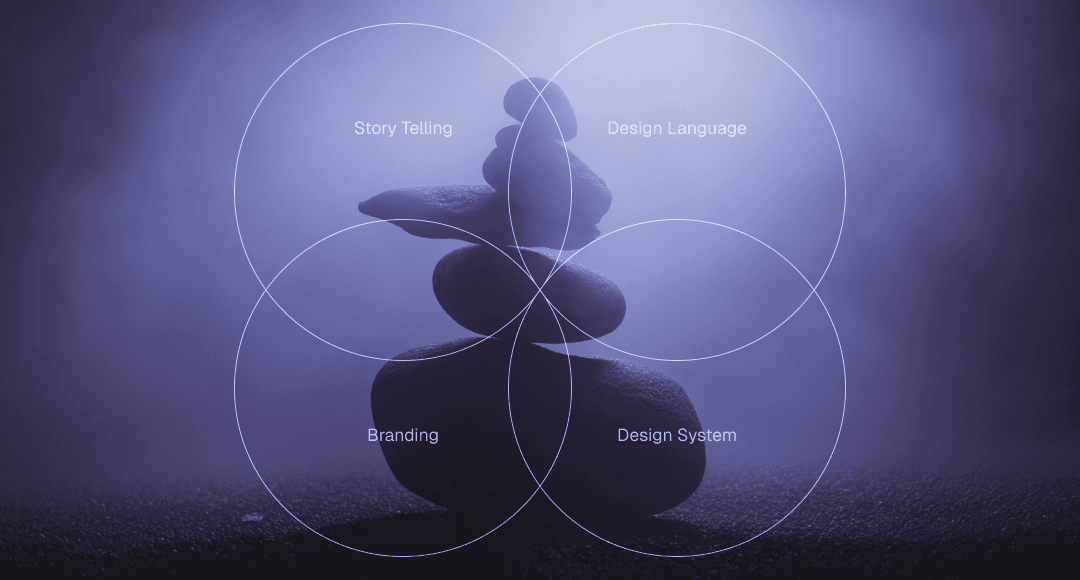
At an early stage, your brand is really a combination of a few core elements:
Positioning — what you do, for who, and why it matters
Messaging — how you explain that clearly and repeatedly
Voice — how you sound across channels
Visual identity — how you look (colors, type, layout, imagery)
Experience — how all of this shows up in real interactions
If one of these shifts depending on where someone meets you, the brand starts to feel unstable.
That’s why just “having a logo” doesn’t fix anything.
The five touchpoints that matter most early
You don’t need to control everything. You just need to control the places people are most likely to see you.
Your website design is the source of truth. If this feels off, everything else inherits the problem.
Social media is your most visible, most inconsistent channel for most startups. Easy to drift with social media design because there are usually lots of assets.
Pitch deck design is often built under pressure — and because of this completely disconnected from the website.
Email marketing design — underrated. High-frequency. Usually ignored from a branding standpoint.
Product or onboarding UI. Especially for SaaS and edtech — this is where brand meets reality. If your product feels like a different company than your marketing, users notice.
Where Brand Consistency Usually Breaks
No founder wakes up and decides to build an inconsistent brand.
It happens gradually — as the company grows, ships faster, and adds more people, tools, and channels.
Founders build assets in survival mode
Early on, everything is reactive.
You need a deck → you build it fast
You need a landing page → you spin one up
You need social content → you post whatever works
Each asset solves a short-term need.
But none of them are built as part of a system.
So over time, you don’t have a brand — you have a collection of outputs.
Too many tools, too many hands
Your brand lives across:
Figma
Canva
Notion
Google Slides
Webflow
Email tools
Product UI
And different people touch each of them:
founders
designers
marketers
freelancers
Without clear rules, each person makes “reasonable” decisions — that don’t match each other.
That’s how subtle inconsistency compounds.
No one documents the basics
This is the silent killer.
Most early-stage teams never define:
exact color usage
typography rules
tone of voice
CTA patterns
image style
So every new asset becomes a fresh interpretation.
Not wildly different — just different enough to break cohesion.
Marketing moves faster than brand
This one is unavoidable.
Marketing has to ship:
campaigns
posts
experiments
landing pages
Brand, on the other hand, is usually “something we’ll fix later.”
So marketing runs ahead without guardrails — and the gap widens.
If you’ve felt this tension, it’s not accidental. It’s structural.
We break this dynamic down further in our startup design process guide, especially around how early teams prioritize speed over systems (and how to rebalance that).
A Lean Brand Consistency System For Startups
You don’t need a full brand book.
You need a branding for startups system that keeps things aligned while you move fast**.
Think of this as a minimum viable brand system — just enough structure to stop the chaos, without slowing you down.
Step 1. Lock the brand basics
Start here. If this isn’t defined, nothing else will stick.
You need:
One clear positioning sentence: (what you do, for who, and why it matters)
3 tone-of-voice traits (e.g. direct, opinionated, practical)
Primary + secondary colors (not 12 variations — keep it tight)
A type pair (headline + body)
Logo usage rules (spacing, backgrounds, do’s/don’ts)
Core CTA language (e.g. “Book a demo” vs “Get started” — pick one and stick to it)
This is your foundation.
Not fancy — but it removes 80% of random decisions.
Step 2. Define channel rules
This is where most startups fall apart.
They either:
make everything identical (which doesn’t work), or
let everything drift (which is worse)
You want a middle ground.
What stays the same everywhere
Core message and value proposition
Tone of voice
Visual cues (colors, typography, spacing feel)
CTA style and intent
This is what creates recognition.
What can flex by channel
Format (carousels vs long-form vs short copy)
Depth of explanation
Platform-native behavior
Consistency doesn’t mean copy-paste.
It means coherence.
Step 3. Build a starter asset kit
Instead of reinventing everything every time, create a few reusable building blocks:
Pitch deck template
Social post templates
Email header + footer
Landing page design sections
Image/icon style references
This is how you scale consistency without increasing effort.
We go deeper into how to make each asset actually pull its weight in your marketing stack in our marketing & design for startups guide.
Step 4. Create one source of truth
If your “brand” lives in:
someone’s head
old Figma files
random Slack threads
…it doesn’t exist.
You need one place where anyone can check:
how things should look
how things should sound
how things should be built
This can be:
a simple Notion page
a Figma file
a lightweight internal doc
The key is accessibility, not perfection.
Step 5. Audit quarterly
Even a good system drifts over time.
Every few months, do a quick sweep:
Website
Social
Product
Emails
Sales materials
You’re not looking for perfection.
You’re looking for:
“Does this still feel like the same company?”
If not, tighten it.
How To Stay Consistent Across Different Marketing Channels
This is where most branding advice falls apart.
It either stays too high-level (“be consistent”) or becomes too rigid (“make everything identical”).
In reality, each channel plays a different role — but they should still feel like they come from the same company.
Website and landing pages
Your website is your anchor.
Everything else should point back to it — not contradict it.
What to keep consistent:
Your core value proposition
Headline structure and clarity
Visual system (spacing, colors, typography)
CTA language
If your homepage says one thing and your landing pages say another, you’re not testing messaging — you’re creating confusion.
Social media
This is where most brands drift.
Why? Because:
it’s fast
it’s frequent
it’s often handled by different people
What should stay consistent:
Tone of voice
Core themes and positioning
Visual direction (even if formats vary)
What can flex:
Content format (carousels, memes, threads)
Level of polish
Platform-native style
You’re not trying to make every post look the same.
You’re trying to make them recognizably yours.
Email is one of the most overlooked brand channels.
But it’s also one of the most frequent touchpoints.
What to align:
Voice (this is where inconsistency shows instantly)
CTA phrasing
Basic visual structure (headers, spacing, buttons)
If your product emails sound corporate but your social sounds human, users notice — even if they can’t explain why.
Pitch decks and sales collateral
Decks are usually built under pressure.
Which is why they often:
don’t match the website
overcomplicate messaging
use completely different visuals
A good rule:
Your deck should feel like a sharper, more structured version of your website — not a different brand.
Product and onboarding
This is where brand credibility gets tested.
Especially in SaaS and edtech:
Users move from your marketing → into your product quickly
Any disconnect feels jarring
What to align:
Tone (error messages, onboarding, tooltips)
Visual system (colors, typography, UI feel)
Language (don’t rename things between marketing and product)
If your marketing promises simplicity but your product feels dense and technical, consistency won’t save you — but inconsistency will definitely hurt you.
When all of these channels are aligned, something subtle happens:
People stop questioning your legitimacy.
And that’s the real job of early-stage startup branding.
Common Mistakes Founders Make
Most consistency issues don’t come from lack of effort.
They come from solving the wrong problem.
Treating consistency as a design-only problem
Founders often think:
“Once we fix the visuals, we’re good.”
But inconsistency usually starts in:
messaging
positioning
tone
If those aren’t aligned, no amount of visual polish will fix the disconnect.
Design doesn’t create consistency — it expresses it.
Making every channel identical instead of coherent
This is the overcorrection.
Everything looks the same.
Everything sounds the same.
Everything feels… flat.
But different channels serve different purposes.
Your website explains
Your social engages
Your emails convert
Consistency is about recognition, not repetition.
Overbuilding a brand system too early
This one wastes time.
Teams spend weeks (or months) creating:
detailed guidelines
edge-case rules
massive documentation
…that no one actually uses.
At this stage, you don’t need completeness.
You need clarity on the basics.
Anything beyond that is premature optimization.
Letting templates replace thinking
Templates are useful — until they become a crutch.
You see this when:
every post looks the same
every slide follows the same structure
every page feels interchangeable
Templates should support decisions, not replace them.
Otherwise, you end up consistent… but forgettable.
What “Good Enough” Brand Consistency Looks Like At Seed Stage
This is where most founders either overthink — or underdeliver.
So let’s set a realistic bar.
At seed stage, “good branding” doesn’t mean polished.
It means coherent enough that people trust what they’re seeing.
Here’s what that actually looks like:
Your core message stays the same across your website, deck, and social
Your visual system is recognizable (even if it’s simple)
Your tone of voice doesn’t shift wildly between channels
Your CTA language is consistent (you’re not saying five different things)
Your assets feel related, not like they came from different companies
That’s it.
Not perfect. Not award-winning. Just… intentional.
If someone:
lands on your site
checks your LinkedIn
opens your deck
…and it all feels connected — you’ve done your job.
Anything beyond this is optimization, not necessity.
FAQ

What is early-stage startup branding?
Early-stage startup branding is the foundation of how your company shows up — across your website, product, social, and sales materials.
It’s not just your logo. It’s your:
positioning
messaging
tone of voice
visual identity
At this stage, branding is less about polish and more about clarity and consistency.
Why is brand consistency important for startups?
Because you don’t have reputation yet.
Consistency acts as a shortcut for trust. When people see the same message, tone, and visual language across channels, your company feels more credible and intentional.
Inconsistency does the opposite — it creates hesitation, even if your product is strong.
How do you keep branding consistent across marketing channels?
You don’t need a massive system.
You need:
clear brand basics (message, tone, visuals)
simple rules for what stays consistent vs what can flex
reusable templates and assets
one source of truth
The goal is not uniformity — it’s coherence across touchpoints.
Do startups need full brand guidelines?
No.
Most early-stage teams overbuild here.
Instead of a 50-page brand book, focus on:
a few core rules
a small set of templates
clear messaging
You can expand later. Early on, speed and clarity matter more than completeness.
What channels should startups prioritize first?
Focus on the highest-impact touchpoints:
Website
Pitch deck
Social media
Email
Product / onboarding
If these feel consistent, the rest matters far less.
Final Thoughts
Early-stage startup branding isn’t about looking impressive — it’s about looking coherent.
When your website, social, emails, decks, and product all feel connected, something shifts. People stop questioning whether you’re legit and start paying attention to what you’re actually building.
If you get consistency right early, everything else — marketing, sales, product — compounds on top of it.
Need a helping hand with nailing this? Book a fit call.